Peace Palace artwork can be seen in colour for the first time in 112 years
The monochrome painting ‘La Glorification de la Paix’ by Luc Olivier Merson hangs in the Small Courtroom of the Peace Palace. The artwork remained colourless as the artist passed away before he was able to complete it. Thanks to Benoît Cordonnier, great-grandson of the architect of the Peace Palace Louis Marie Cordonnier, one can now see how the artwork would have looked in colour.
Acquisition of the gouache painting
During the construction of the Peace Palace in the period 1907-1913 more than 50 countries contributed building materials or artworks to indicate their support. The French government donated three paintings at that time of which ‘La Glorification de la Paix’ is one and it has been hanging in the Small Courtroom of the Peace Palace since 1913. It is a full-scale (3.5×4.25 meter) study in monochrome brown tones which was to have been replaced by a Gobelin tapestry to be woven in colour with the same design. Unfortunately, Luc Olivier Merson, the artist, passed away in 1920 before the tapestry was completed and thus the study from 1913 has always remained in its place in the courtroom.
Recently, Benoît Cordonnier, the great-grandson of the architect of the Peace Palace, Louis Marie Cordonnier, contacted the Carnegie Foundation as owner and manager of the Peace Palace. It emerged that the Cordonnier family archive contained a colour gouache painting of ‘La Glorification de la Paix’. This gouache painting is a preliminary study of the artwork and, as evidenced by an inscription on the rear, Luc Oliver Merson had gifted it to architect Cordonnier in 1917.
The Carnegie Foundation has been able to acquire this gouache painting thanks to funds received from a legacy. For the first time since the painting was hung 112 years ago, parties involved in court proceedings as well as other visitors can now see how the artist had intended the completed artwork would look. Jacobine Wieringa, curator at the Carnegie Foundation, is enthusiastic about the acquisition: “With this gouache, we understand how Merson envisaged the final artwork; we can suddenly see it through his eyes. After more than a century, ‘La Glorification de la Paix’ has gained a new dimension.”
Meaning of the painting
The canvas depicts the goddess of peace sitting on her throne. She is preventing Mars, the god of war, from rising by placing her feet on him. The peace goddess is surrounded by virtues that contribute to peace and benefit from a peaceful existence. In her left hand, the goddess holds a dove and in her right hand an olive branch: both ancient symbols of peace. Behind her victories announce the triumph of peace. On the left side of the canvas, the virtues of justice, wisdom, the arts and reason are depicted. The right side of the canvas shows characters representing work, steadfastness, unity and science.
Placement of ‘La Glorification de la Paix’
The gouache painting is in excellent condition thanks to careful preservation in the Cordonnier family archive. To make the artwork future-proof, the Carnegie Foundation will be taking further conservation measures such as the use of museum glass and checking the original passe-partout. Iljan van Hardevelt, director of the Carnegie Foundation, states: “We will exhibit the coloured gouache painting close to the large monochrome canvas. By placing the artworks next to each other in the Small Courtroom, one can now, literally, see the colours of the vision of Peace Through Law.”
Carnegie Foundation – Peace Palace
The Carnegie Foundation is the owner and manager of the Peace Palace in The Hague. The Peace Palace houses the Permanent Court of Arbitration, the International Court of Justice of the United Nations, The Hague Academy of International Law and the Peace Palace Library.
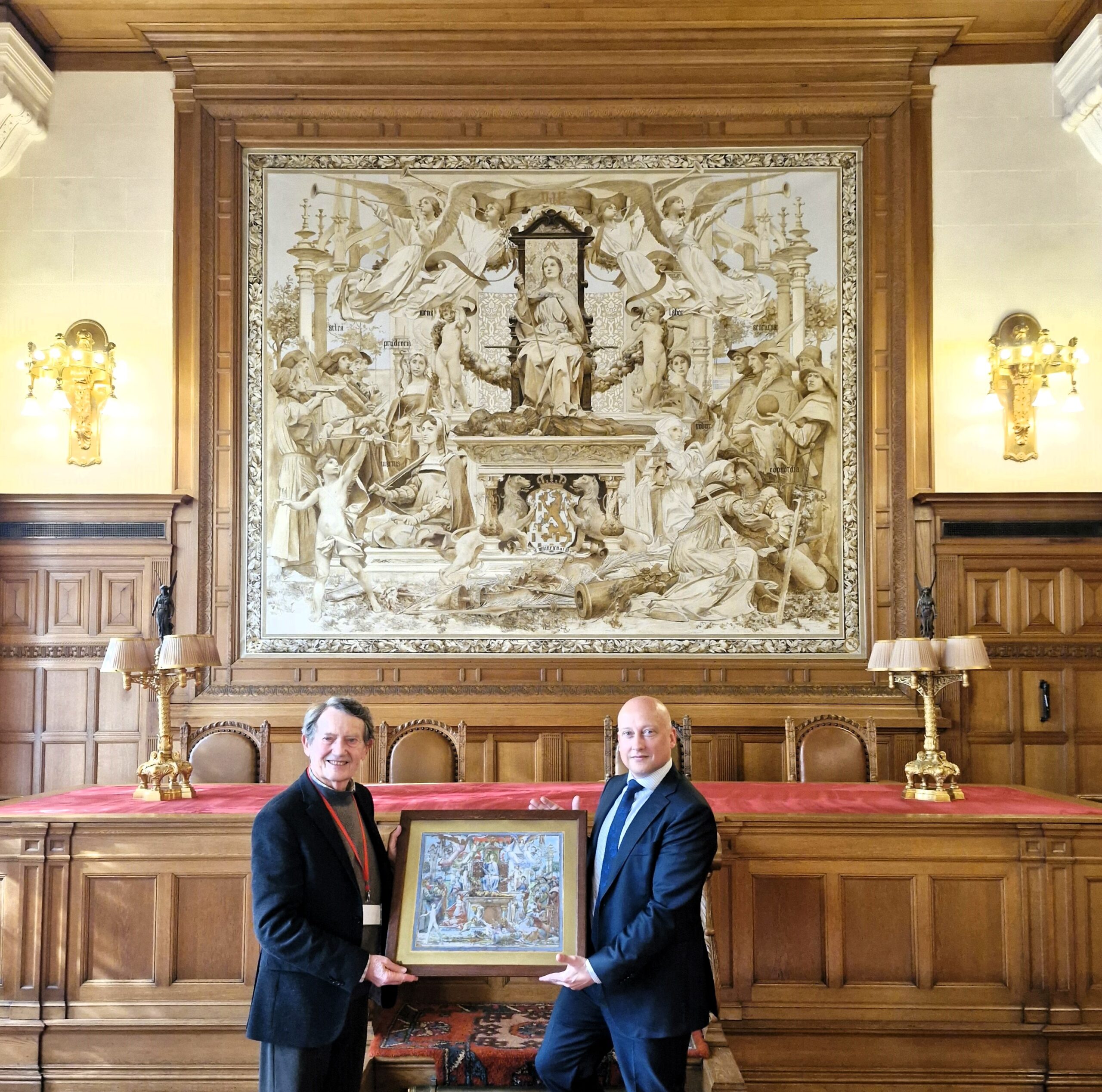
Benoît Cordonnier and Iljan van Hardevelt in the Small Courtroom of the Peace Palace

Luc Olivier Merson, Gouache “La Glorification de la Paix”, 1917

Luc Olivier Merson, monochrome painting “La Glorification de la Paix”, 1920